
Dendera | Nile | Valley of The Kings | Karnak | Abu Simbel | Hieroglyphs | Cartouches | Luxor temple | Hatshepsut | British Musuem | Changing Gallery | Edfu | Philae | Colossi | Kom Ombo | Mummified Animals | Sphinx | Pyramids| Home | About Egyptianholiday
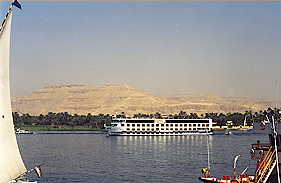 |
The Nile is the world's longest river: believed to be around 6680 km long it runs through nine different countries. Yet it is Egypt, that has managed to reap the greatest benefits from it's journey. As the source of life for Egypt the Nile's banks reveal the history of Ancient Egypt. Lined with towns from Rosetta near the Mediterranean Sea through to Abu Simbel on the borders of Sudan, the Nile illustrates the lives and beliefs of the Egyptians since ancient times. From your visits to other pages on Egyptianholiday, you will notice that many historical and archaelogical sites are located on or near the River Nile. | ||
 |
Since Ancient times, the Egyptians have used the nutrients from the Nile to nourish their crops. The Ancient Egyptains believed that Egypt was split into either "Blackland" or Redland. Whereas the deserts were known as "Redland" and barren, the Nile was known as the "Blackland" and fertile; as it's banks contained silt (black substance), left by the river when it to rose each year and flooded the land. Nile derives its name from the Greek word "Nelios" which means River Valley. Originally the Nile Valley and surrounding countryside was green and productive but due to climatic changes the rainfall stopped. Now due to the annual floods, a strip of fertile green land land runs along the river edge whilst the remaining countryside which the flood water is unable to reach, is dry desertland. | ||
|
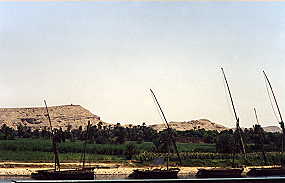
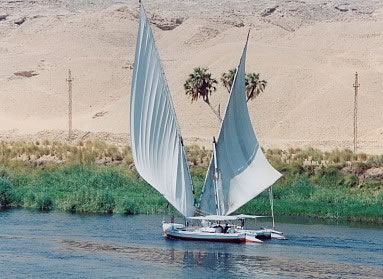
As simply waiting for "nature to work its magic" was unreliabe, the Ancient Egyptians used various irrigation methods including canals, basins, dams and dykes. However It wasnt until 1971 when the High Dam at present day Aswan was finally completed, that the Egyptians finally achieved control of the river for effective agriculture and power generation. A number of different crops were grown during the Pharaonic period including Barley, Emmer(type of wheat), Lentils, Beans, Dates and Figs. Flowers were used to make honey and animals such as Oxen, Goats, Pigs and Ducks were raised. The long line of felucca boats (sailing along the Nile) in the photograph above left demonstrate the heavy reliance many locals have on the Nile even in today's world. |
||
 |
The Nile penetrated every aspect of ancient Egyptain life including religion - for example the ancient Egyptians believed that each day, the sun god Ra was transported across the sky in a boat. Considering that travel by Nile was the usual manner in which ancient Egyptians travelled, it easy to see how they may have formed such a belief. Even the temples contained images of the Nile including its waves and flowers. Travel by land was extremely rare, until at least the 19th century and contrary to popular belief, camels were introduced in Egypt by foreign conquerors such as Assyrians, Persians, Alexander the Great. One of the seven wonders of the world the pyramids were built through transporting Granite on the Nile. Even the ancient Egyptian calendar was divided into 3 seasons based on the cycles of the Nile. | ||
 |
 |
||